
The moment it starts breaking
“Where is this order?”
It sounds like a simple question.
But in most growing manufacturing setups, it triggers a chain reaction.
Someone checks a spreadsheet.
Someone else says they will call the shop floor.
Another person tries to trace the last update.
And after a few minutes, the answer comes back:
“Let me confirm and get back.”
Not because people are careless.
Because the system doesn’t actually know.
There is no single place that shows:
- the last activity on the order
- the current stage
- what has been completed
- what is pending
Everything depends on who knows what.
This is not a tool problem
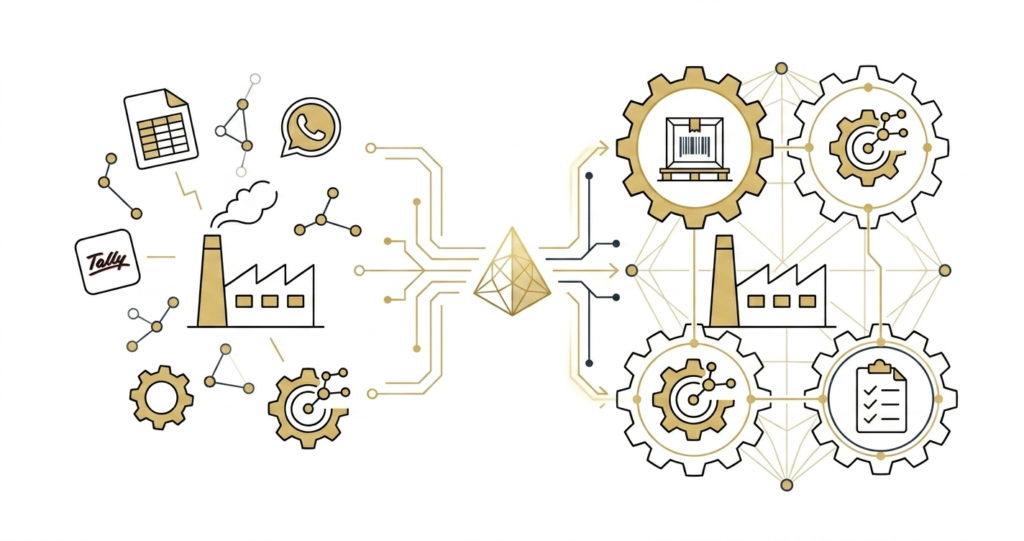
Most businesses at this stage are already using something.
- Excel or Google Sheets for tracking
- Zoho Books or Tally for accounting
- Calls and WhatsApp for coordination
On paper, it feels manageable.
But as orders increase, something starts to slip.
Not production.
Not effort.
Visibility.
Where things quietly fall apart
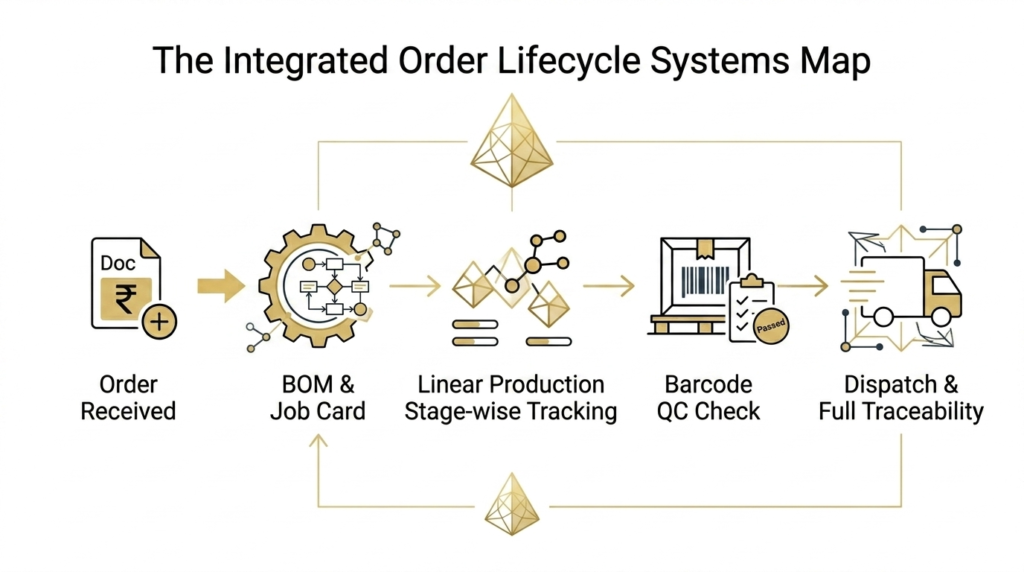
Let’s take a simple flow.
An order comes in.
Specifications are decided.
Materials are allocated.
Production starts.
Quality is checked.
Dispatch happens.
Nothing unusual.
But look closer at how this is actually handled:
- Order details sit in one sheet
- Material allocation in another
- Job status is followed up manually
- QC is done, but not recorded anywhere
- Dispatch is updated separately
At no point does the system show the full picture.
So the business runs on:
- follow-ups
- memory
- individual ownership
Not on a structured workflow.
WIP is not really tracked
Most teams will say they track work in progress.
But what that usually means is:
Started
In progress
Completed
That’s not WIP visibility.
There is no clarity on:
- which stage a job is in
- how long it has been there
- whether it is delayed
- how it impacts delivery timelines
So unless someone is constantly checking,
jobs disappear from attention.
QC happens. But it leaves no data behind
Quality checks are not ignored.
They are happening physically on the floor.
But nothing is captured in a way that helps later.
There is no record of:
- what failed
- how often it failed
- which batch had issues
- who handled it
So every issue is treated like a one-off.
There is no way to step back and ask:
“Is this pattern repeating?”
Traceability exists. But only if someone remembers
If a product fails, teams can usually trace it.
But the process is manual.
They check:
- product SKU
- past records
- vendor details
- batch information
And slowly piece it together.
It works when volumes are low.
But as complexity increases, this becomes fragile.
Traceability should not depend on effort.
It should be built into the system.
The real reason this breaks
WIP, QC and traceability don’t fail because teams are not capable.
They fail because there is:
no integrated system that connects the workflow and captures data at each stage
Each function works.
But they don’t work together.
Why standard tools don’t solve this
Zoho Books is strong for accounting and basic stock.
Zoho Inventory helps manage stock movement and warehouses.
But neither is designed to handle:
- stage-wise production tracking
- job-level workflows
- QC data capture
- traceability mapping across BOMs
So businesses end up stretching tools beyond their purpose.
And then filling the gaps with Excel.
If you’re trying to understand how Zoho Books, Inventory and Creator fit together at a system level, we’ve broken it down here.
Where Zoho Creator actually fits
Zoho Creator is often misunderstood.
It is not useful because it is customizable.
It is useful because it allows you to build a system that matches how your business actually runs.
This is where things change.
You can define:
- how a job is created
- how materials are allocated
- how each stage is tracked
- how QC is recorded
- how batches are linked
- how everything connects back to orders and inventory
And once this is in place:
Every activity leaves a record.
Every stage becomes visible.
Every issue becomes traceable.
What changes once the system is in place
The difference is immediate.
You no longer ask:
“Where is this order?”
You can see it.
You know:
- which stage it is in
- what is pending
- how long it has been there
Quality is no longer just a check.
It becomes data.
You start seeing:
- patterns
- recurring issues
- actual root causes
Traceability becomes instant.
From a finished product, you can move backwards:
- to BOM
- to batch
- to vendor
Without chasing information.
And most importantly:
The business stops depending on people to remember things.
The shift that actually matters
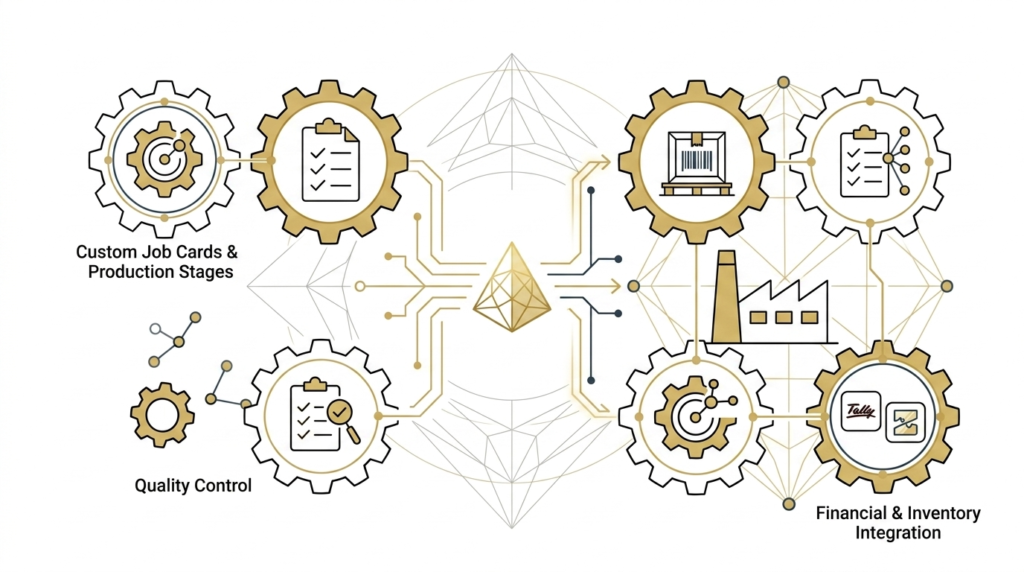
Most businesses try to solve this by adding tools.
But tools don’t fix workflows.
Systems do.
Once the workflow is designed properly,
Zoho Creator becomes the layer that brings it together.
If you’re seeing this in your operations
- Orders are tracked in Excel
- WIP is not clearly visible
- QC is happening but not recorded
- Traceability takes effort
Then the issue is not complexity.
It is structure.
How we approach this at Imploris
We don’t start with tools.
We start with how your workflow actually runs.
- where orders originate
- how production moves
- where visibility breaks
- what needs to be tracked
Then we design a system that fits your operations
and implement it using Zoho Creator, along with Books and Inventory where needed.
If you want to understand where your current setup stands,
we can walk through it together.
A one-hour discussion is usually enough to identify the gaps
and outline what a structured system would look like.