
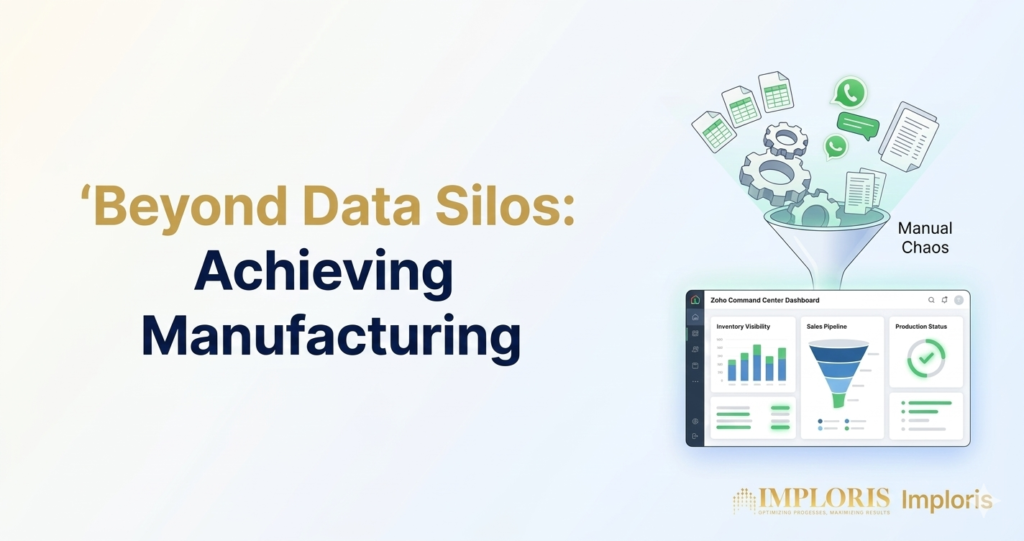
Manufacturing businesses rarely struggle because they lack effort. Most founders and teams work extremely hard to keep production moving, manage inventory, fulfill orders, and maintain customer relationships.
The challenge is usually something deeper: information does not flow clearly across the business.
Sales teams promise delivery dates without knowing production capacity. Inventory teams struggle to maintain accurate stock visibility. Finance may have the numbers, but operations and sales may not be aligned with them.
Over time, this creates a familiar pattern in many manufacturing MSMEs: information scattered across Excel sheets, WhatsApp messages, emails, and verbal coordination.
This is where a well-designed digital system begins to make a difference.
The Real Operational Problems Manufacturing MSMEs Face
Across many manufacturing businesses—whether in electronics, machinery, textile production, or assembly units—similar operational challenges appear again and again.
One of the biggest issues is sales-to-production visibility.
Sales teams receive enquiries and confirm orders, but production teams may not immediately see what needs to be manufactured, what inventory is available, or whether new materials must be purchased. This disconnect creates delays and constant follow-ups.
Inventory management is another recurring challenge. Without a centralized system, it becomes difficult to track:
- What materials are available
- What is already committed to orders
- What needs to be restocked
- What is currently in production
In many cases, businesses maintain inventory records in spreadsheets or isolated systems, which makes it difficult to get a reliable real-time view.
Communication itself also becomes fragmented. Teams often rely on multiple channels—WhatsApp, phone calls, emails—without a central system that captures and connects the data.
For leadership, this creates a familiar frustration: data exists everywhere, but meaningful insight is still difficult to obtain.
Where Information Typically Breaks
In many manufacturing organizations, the most critical breakdown happens between sales, operations, and delivery.
A sales order may be confirmed without a clear understanding of whether the product is:
- Available in stock
- Already reserved for another order
- Scheduled for production
- Dependent on incoming materials
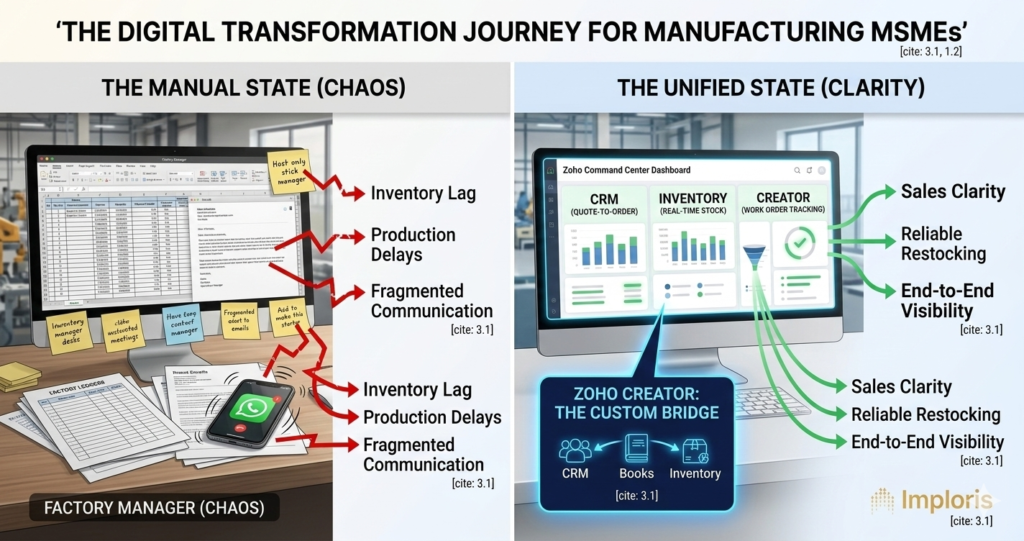
When the system does not connect these functions, teams rely on manual coordination.
This problem becomes even more visible in businesses that manufacture products but also distribute through dealers or distributors. Managing distributor demand, production schedules, inventory levels, and receivables becomes extremely complex without a well-structured system.
Receivables are another common challenge. When sales, invoicing, and payment tracking are not integrated into a single workflow, finance teams spend significant time chasing information and reconciling records.
These issues are rarely about people or effort—they are about how systems are designed and implemented.
The Role Zoho Can Play in Manufacturing Systems
Zoho’s ecosystem offers a flexible way to address many of these operational challenges. Rather than forcing a rigid ERP structure from the beginning, Zoho allows businesses to build a modular system that grows with the organization.
For many manufacturing MSMEs, Zoho Books becomes the financial backbone. It manages accounting, invoicing, purchases, and compliance in a way that is familiar and manageable for growing businesses.
When sales activity increases, Zoho CRM becomes valuable. It provides visibility into enquiries, customer interactions, and order pipelines, helping businesses track demand and improve coordination with operations.
Inventory management can be handled through Zoho’s inventory capabilities, ensuring that material movement, stock levels, and order commitments are recorded properly.
For businesses that want deeper insights into operations, Zoho Analytics provides dashboards and reporting that allow leadership teams to understand what is happening across functions.
Where Zoho Creator Becomes Critical
Manufacturing environments rarely fit perfectly into standard software modules.
Every factory has unique workflows, production stages, quality checkpoints, and coordination requirements with suppliers or subcontractors. Trying to force these workflows into rigid systems often creates resistance from teams.
This is where Zoho Creator becomes extremely valuable.
Creator allows businesses to build custom applications that reflect how their operations actually work.
For example, a manufacturing system may require modules such as:
- Work order tracking
- Production stage monitoring
- Job work management with external vendors
- Quality control checkpoints
- Production status updates
These modules can be designed specifically for the business and connected seamlessly with other Zoho applications like CRM, Books, and Inventory.
Instead of forcing teams to adapt to software, the system adapts to the workflow.
Why Many Manufacturing Businesses Struggle With Digital Tools
One of the most common misconceptions among founders is expecting software to automatically solve operational problems.
In reality, software is only an enabler.
If processes are unclear, teams are not aligned, or data discipline does not exist, implementing new tools will not magically fix the situation.
Another common mistake is implementing systems without preparing the team. Employees who are comfortable with spreadsheets and informal coordination may resist new tools if they are not introduced thoughtfully.
Some businesses also attempt to replicate their existing Excel sheets inside ERP systems, which often leads to complicated configurations that are difficult to maintain.
Successful digital transformation requires more than software—it requires clear processes, team alignment, and thoughtful system design.
What Changes When Systems Are Designed Properly
When manufacturing systems are implemented well, the most noticeable change is visibility.
Leadership teams gain a clearer view of what is happening across sales, production, inventory, and finance.
Teams spend less time coordinating through calls and messages because the system itself provides the necessary information.
Order tracking becomes faster. Production planning becomes more reliable. Financial clarity improves because transactions and operations are connected.
Perhaps most importantly, businesses gain confidence in the numbers they see.
When data flows consistently through the system, decision-making becomes faster and more reliable.
A System-First Approach to Digital Transformation
For manufacturing businesses considering digital transformation, the most important principle is simple:
Software alone does not solve manufacturing problems.
What matters is designing a system that reflects the real processes of the business and then choosing tools that support that system.
Platforms like Zoho provide a powerful foundation, but the real value comes from how those tools are configured and connected to the way the business operates.
When process design, team adoption, and software implementation come together, manufacturing businesses can finally achieve what they have been seeking all along: clarity, coordination, and control across the organization.
Next Step for Manufacturing Businesses
If you are evaluating how to improve visibility across sales, production, inventory, and finance, the first step is not selecting software—it is understanding how your current system actually works.
Once that clarity is established, choosing the right digital tools becomes much easier.
👉 Process Clarity Discussion