
Walk into many growing manufacturing businesses and you’ll notice something reassuring.
Production is moving.
Machines are running.
Operators are working through their assigned jobs.
Materials are being issued.
Job cards move from one workstation to another.
At first glance, everything appears to be under control.
Now ask a simple question.
“Where exactly is this order right now?”
The answer is rarely immediate.
Someone walks to the production floor.
Someone checks a clipboard.
Someone calls the production supervisor.
Someone opens an Excel sheet.
Eventually, the answer arrives.
The challenge isn’t that people don’t know what they’re doing.
The challenge is that visibility has stopped moving with the work.
Paper job cards have supported manufacturing operations for decades. They help communicate work instructions, record production activities, and guide operators through different stages of manufacturing.
The problem isn’t the paper.
The problem begins when information captured on the job card remains isolated while the rest of the business continues making decisions.
As production volumes increase, businesses need more than historical records. They need operational visibility that moves alongside production.
Why Manufacturers Continue Using Paper Job Cards
There is a reason paper job cards still exist across many manufacturing businesses.
They are simple.
Operators understand them.
No training is required.
A supervisor can quickly issue work instructions, record quantities, make notes, obtain signatures, and move the job to the next workstation.
For smaller operations with limited production activity, this approach often works reasonably well.
The challenge appears when the business grows.
More orders.
More operators.
More work centres.
More subcontractors.
More customer commitments.
At that point, the paper card continues to move through production, but management gradually loses visibility into everything happening around it.
Where Production Visibility Begins to Break
A paper job card records what happened.
It rarely tells management what is happening.
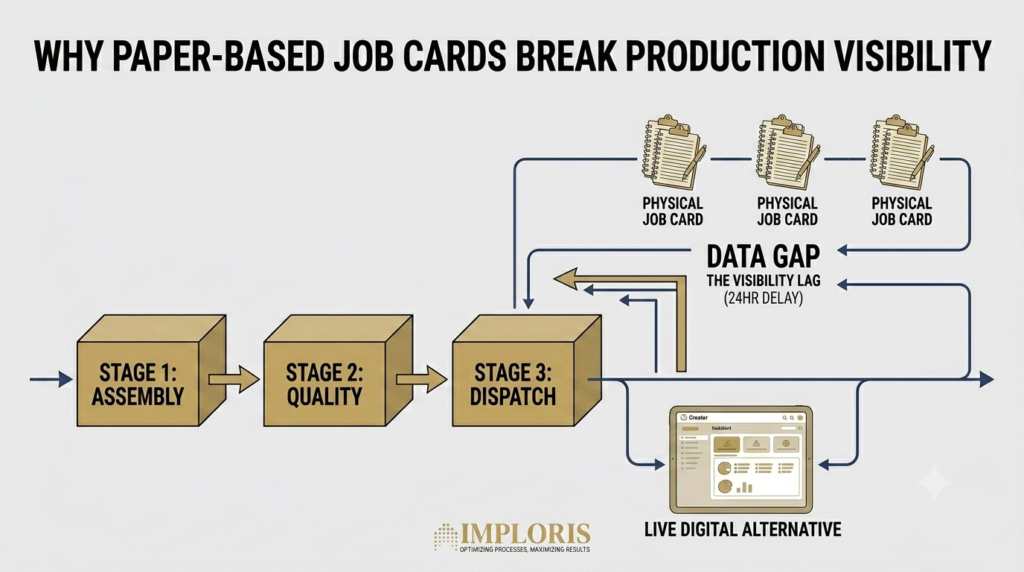
As work progresses through different production stages, the information remains with the physical card.
Sales cannot see it.
Procurement cannot see it.
Accounts cannot see it.
Management cannot see it.
The only people who know the actual status are usually standing near the job.
This creates an invisible operational gap.
Production may be progressing exactly as planned.
But the business has no reliable way of understanding that progress without manually asking someone.
As order volumes increase, this becomes increasingly difficult to manage.
Three Places Where Visibility Is Usually Lost
1. The Visibility Lag
A production operator completes today’s work.
The job card is updated.
The production continues.
But the information remains on the shop floor until someone manually updates another system later.
Sometimes that happens at the end of the shift.
Sometimes the following morning.
Sometimes it is never updated.
This means management is constantly reviewing yesterday’s information while trying to make today’s decisions.
2. The Transcription Gap
Many businesses eventually transfer information from paper into Excel or another operational tracker.
Although this creates digital records, it introduces another challenge.
Information is copied manually.
Quantities are entered.
Dates are updated.
Comments are interpreted.
Every manual transfer creates another opportunity for error.
A missing digit.
An incorrect quantity.
A skipped update.
Over time, these small inconsistencies reduce confidence in production information.
Eventually, people stop trusting the reports and return to asking individuals for updates.
3. The Vendor Visibility Blackout
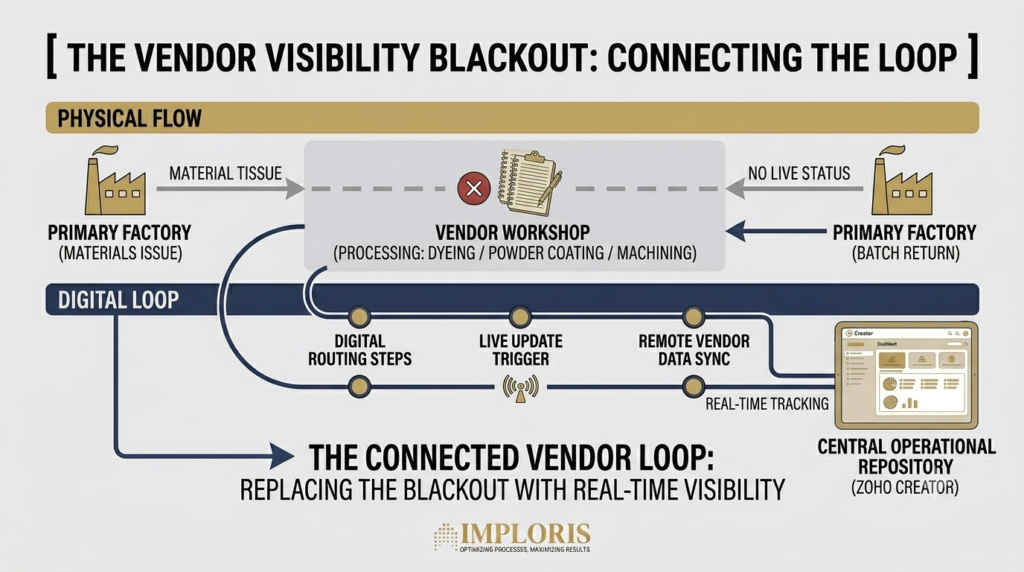
Many manufacturers outsource specific production activities.
Examples include:
- Dyeing
- Embroidery
- Powder coating
- Surface treatment
- Machining
- Assembly
- Finishing
Materials leave the factory together with a job card.
From that moment onwards, visibility becomes limited.
Management often knows:
The material has left.
They know when it should return.
What they do not know is:
- Has work started?
- Is production delayed?
- Is rework required?
- Has additional material been consumed?
- When will the batch actually return?
Until somebody calls the vendor, the business is effectively operating without visibility.
This is one reason why structured job work tracking becomes increasingly important as manufacturing operations scale.
Operational Checkpoint: Visibility Diagnostic
If your production lines are still running on paper routing slips, ask your floor manager these questions before the shift ends:
The Job Card Is Not the Problem
It is important to make one thing clear.
Paper job cards are not the enemy.
They remain valuable operational documents.
The challenge begins when the information recorded on them stays disconnected from the rest of the business.
A production update should not remain on a clipboard.
It should naturally become part of the operational workflow.
Sales should understand production progress.
Procurement should understand material consumption.
Quality teams should know where inspections are pending.
Dispatch should know what is ready.
Management should know where attention is required.
Visibility should move with the work.
Building Connected Production Visibility
Improving production visibility does not start with replacing paper.
It starts with understanding how work actually flows through the business.
A structured approach typically includes:
- Clearly defined production stages
- Standardised job cards
- Material issue tracking
- Work-in-progress visibility
- Vendor job work tracking
- Quality checkpoints
- Dispatch readiness
- Shared operational dashboards
Once these checkpoints are defined, technology can support the process instead of forcing people to change the way they naturally work.
This is where many growing manufacturers benefit from building a connected operational layer that links production activities with inventory, quality, dispatch, and finance.
The objective is not simply digitising paper.
The objective is creating operational visibility across the business.
Imploris Thoughts
Manufacturing businesses rarely struggle because people stop working hard.
They struggle because information becomes fragmented as operations grow.
The paper job card that worked well when handling a handful of jobs each day becomes increasingly difficult to manage when dozens of orders, multiple vendors, and several production stages are running simultaneously.
The answer is not to remove operational discipline.
It is to strengthen it.
When information moves alongside production instead of remaining isolated on paper, managers make better decisions, teams spend less time searching for updates, and customers receive more accurate commitments.
Ultimately, the goal isn’t a paperless factory.
It’s a business where visibility moves with the work.
Operational Reflection
If your production team still relies on paper job cards, spreadsheets, and manual follow-ups to understand what’s happening on the shop floor, it may be time to review how information flows through your operations.
At Imploris, we begin with a structured manufacturing discovery process to understand how orders, materials, production, quality, and dispatch move across your business before recommending any technology.
The outcome isn’t simply a software implementation.
It’s a clearer operational blueprint designed around the way your business actually works.