
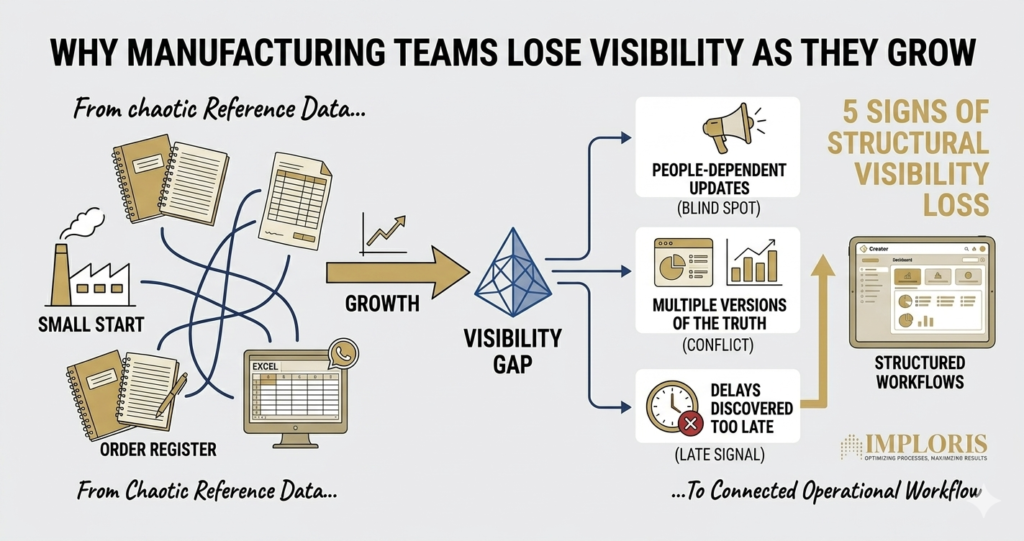
A growing manufacturing business rarely loses visibility overnight.
It happens gradually.
The first few customers are easy to manage.
Orders are tracked in spreadsheets.
Procurement discussions happen over WhatsApp.
Production updates are shared verbally.
Dispatch plans sit on a whiteboard.
The owner knows exactly what is happening because most decisions pass through a small group of people.
Then growth happens.
More enquiries arrive.
More orders are accepted.
More vendors are added.
More production activities need coordination.
More people become involved.
And suddenly the same methods that supported growth begin creating confusion.
The problem is not that teams stop working hard.
The problem is that information starts living in too many places.
The Visibility Problem Usually Starts Small
In many growing businesses, information gets distributed across multiple systems:
- Excel files
- WhatsApp groups
- Emails
- Tally
- Physical boards
- Personal notebooks
Each tool solves a local problem.
But none of them provide a complete picture.
This often starts with spreadsheets that were originally created to simplify tracking. Over time, however, multiple versions emerge, manual updates increase, and the business begins relying on individual knowledge rather than structured processes. We explored this challenge in more detail in our article on Why Excel-Based Manufacturing Systems Stop Scaling.
As a result, management starts asking simple questions that become surprisingly difficult to answer.
Questions such as:
- Which orders are currently delayed?
- What is pending procurement?
- Which jobs are waiting for production?
- What is ready for dispatch?
- Which vendor is holding materials?
- What customer follow-ups are overdue?
The information may exist somewhere.
The challenge is finding it quickly and confidently.
When Growth Creates Blind Spots
Many businesses experience this challenge when transaction volumes increase.
The issue is not company size.
The issue is operational complexity.
A team that once handled ten active orders may now be managing fifty.
A sales coordinator may be tracking hundreds of follow-ups.
Procurement teams may be communicating with dozens of vendors.
Production teams may be working on multiple jobs simultaneously.
The existing tools continue to function.
But visibility starts breaking down.
The Five Common Signs Visibility Is Being Lost
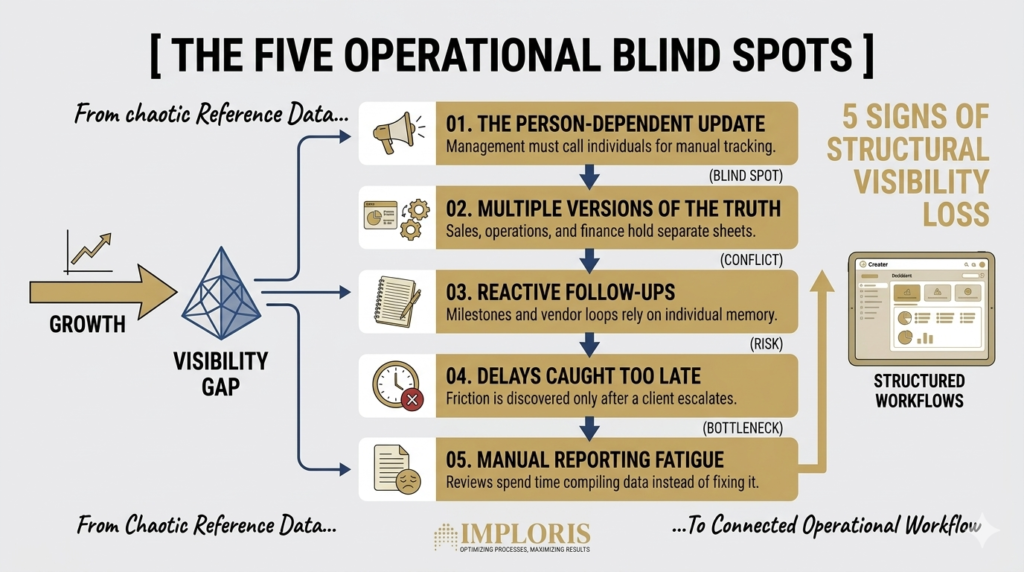
1. Management Depends on People for Updates
Instead of opening a dashboard, managers must call individuals for status updates.
Information becomes person-dependent.
2. Multiple Versions of the Truth Exist
Sales has one spreadsheet.
Operations has another.
Accounts has different information.
Nobody is completely certain which version is correct.
Material information is particularly vulnerable to this problem. Procurement may have one version of stock availability, production may be working from another estimate, and accounts may see a completely different cost picture. These disconnects eventually surface as material consumption and costing issues, which we discussed in Material Variance in Manufacturing: What MSMEs Often Miss.
3. Follow-Ups Become Reactive
Customer follow-ups, vendor reminders, and payment collections depend on memory rather than structured workflows.
4. Delays Are Discovered Too Late
Teams often learn about delays only after customers begin asking questions.
In many cases, delays are not caused by production itself but by missing visibility into outsourced activities, vendor coordination, and material movement. This is especially common in businesses that rely heavily on subcontracting and external processing. Our article on How Manufacturing MSMEs Can Track Job Work & Outsourcing Properly explores these challenges further.
5. Reporting Requires Significant Manual Effort
Weekly reviews become exercises in collecting information instead of analyzing it.
Visibility Is Not a Software Problem
Many businesses assume they need a new software application.
In reality, visibility problems usually start much earlier.
The root cause is fragmented processes.
When information moves through spreadsheets, messages, notebooks, and disconnected systems, visibility naturally decreases as the business grows.
Technology alone cannot solve that challenge.
Structured workflows are equally important.
The objective is not necessarily to implement a large ERP system. Many growing manufacturers benefit more from connecting critical operational processes through a structured “semi-ERP” approach that aligns sales, inventory, production, job work, quality control, and dispatch. We explained this concept in Designing a Semi-ERP for Manufacturing MSMEs Using Zoho Creator.
What Better Visibility Looks Like
Operational visibility improves when businesses establish:
- A single source of truth
- Standardized workflows
- Defined ownership
- Consistent status tracking
- Structured reporting
- Shared operational dashboards
The objective is not more reports.
The objective is knowing what is moving, what is delayed, and what requires attention.
Without asking five different people.
Visibility also depends on having clear production checkpoints. Without structured work-in-progress tracking, quality control checkpoints, and traceability records, managers are often forced to rely on phone calls and status meetings. We covered these operational controls in WIP, QC & Traceability Workflows Using Zoho Creator.
Our Thoughts
Visibility improves significantly when operational activities are connected from enquiry through dispatch rather than managed as isolated departmental activities. Our Order to Dispatch: How Manufacturing Workflows Should Actually Flow article provides a practical blueprint for this approach.
Most growing manufacturing businesses do not struggle because they lack effort.
They struggle because operational visibility has not kept pace with growth.
The spreadsheets that once worked become harder to manage.
The WhatsApp groups multiply.
The manual updates increase.
Eventually, management spends more time searching for information than acting on it.
That is usually the point where structured workflows become less of a technology project and more of a business necessity.