
When materials become the real problem
There’s a point in manufacturing where materials stop being just “items” and start becoming the core of how the business runs.
Not when systems are implemented.
Not when processes are documented.
But when someone asks:
“What exactly went into this product?”
And the answer depends on memory.
BOM exists, but not as a system
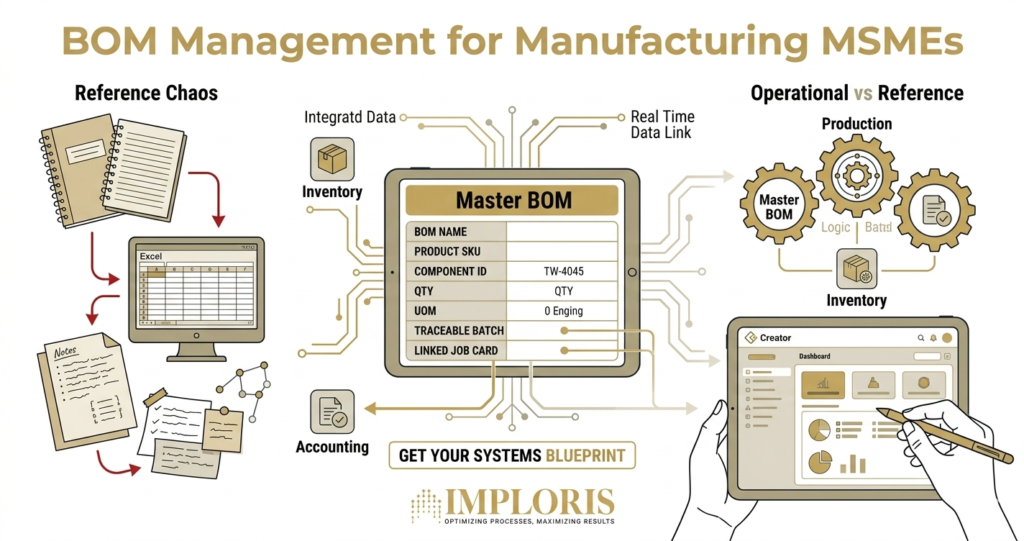
In many MSME setups, bill of materials is not missing. It exists. People know what goes into a product. They’ve been doing it for years.
In some cases, it is written in notebooks.
In others, it sits in Excel.
But the structure is rarely consistent. More importantly, it is not connected to how production actually happens.
In a textile setup, materials are handled practically. Items are stacked, grouped, and understood by experience. There is no strict tagging or structured separation.
In electronics or EV-related setups, BOM may exist in Excel. But the connection between BOM, job execution, and actual usage is still weak.
So BOM exists, but it doesn’t function as a system.
Where things start slipping
Production continues. Orders are fulfilled. Materials move.
Everything looks fine.
But slowly, gaps appear.
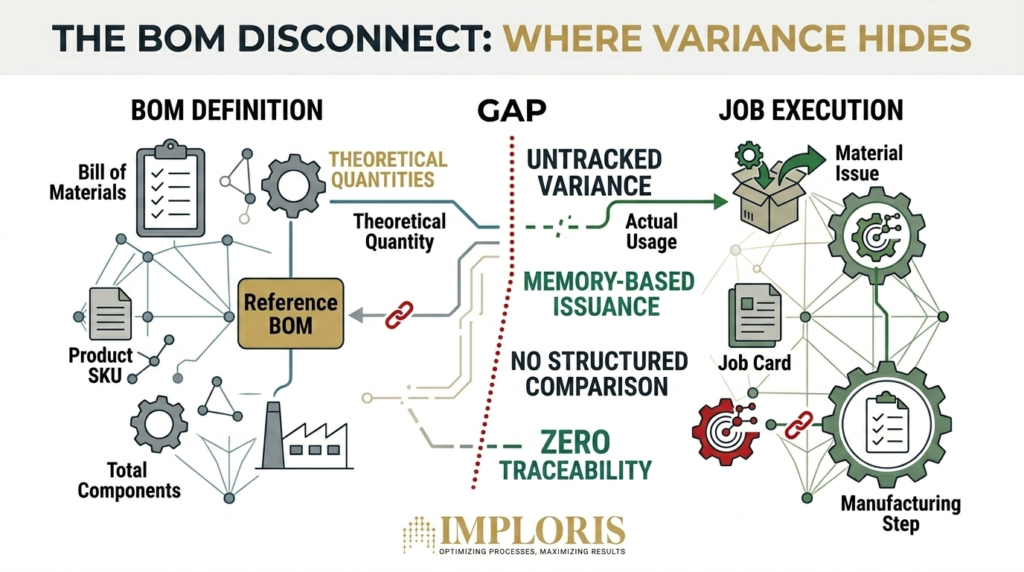
Materials go out without being tied clearly to a job.
Finished goods come back without a structured comparison.
Variance is accepted, but not measured.
In industries where materials are measured in grams and multiple components go into one product, this becomes critical.
Small differences start adding up.
Without a system, there is no clarity on whether the variance is acceptable or silently affecting margins.
When traceability becomes difficult
The real issue shows up when something goes wrong.
A product has an issue. A batch needs to be checked.
The question becomes:
“Which materials were used?”
In theory, the answer exists.
In practice, it takes effort.
Someone checks past entries.
Someone recalls how the job was done.
Someone tries to piece together the flow.
Traceability depends on memory.
The real problem with BOM
At this point, BOM is not failing because it doesn’t exist.
It is failing because:
- it is not linked to jobs
- material issue is not tracked properly
- actual usage is not recorded
- variance is not visible
- traceability is not built into the workflow
BOM becomes a reference, not an operational system.
What changes when BOM is structured properly
When BOM is connected to production, things become clear.
For every job, you know:
- what materials are required
- what is issued
- what is consumed
- what is returned
Material movement becomes part of the workflow.
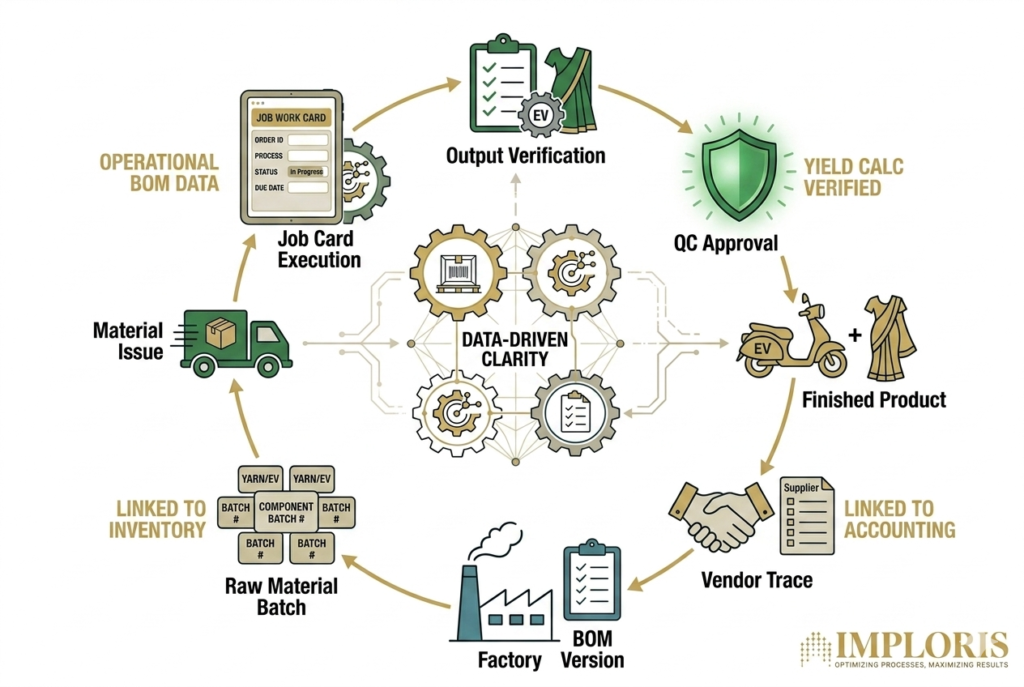
In systems we’ve implemented, BOM is tied directly to job cards.
As materials are issued, it is recorded.
As output comes back, it is verified.
Variance is no longer guesswork.
It is visible.
How traceability becomes practical
Once this structure is in place, traceability becomes natural.
You can move from:
finished product → job → BOM → materials → vendor or batch
Without effort.
Without relying on memory.
Where Zoho Creator fits in
Standard tools are not designed to handle this depth of workflow.
This is where a custom layer becomes necessary.
Zoho Creator allows you to define:
- how BOM is structured
- how it connects to jobs
- how materials are issued and tracked
- how usage is recorded
- how variance is calculated
Once connected with inventory and accounting, the full picture becomes visible.
What actually breaks in BOM
BOM does not break because teams don’t understand materials.
It breaks because there is no system connecting:
material definition → issue → usage → output
When these are disconnected, clarity is lost.
If this feels familiar
If your current setup involves:
- loosely defined BOMs
- manual material tracking
- reliance on experience
- difficulty in tracing usage
Then the issue is not complexity.
It is structure.
How we approach this at Imploris
We start by understanding how materials actually move in your business.
Not on paper, but in reality.
From there, we design a system that connects BOM, job work, and inventory into one flow, and implement it using the right tools, including Zoho Creator where needed.
If you want to evaluate your current setup, we can walk through it together and identify where the gaps are.