
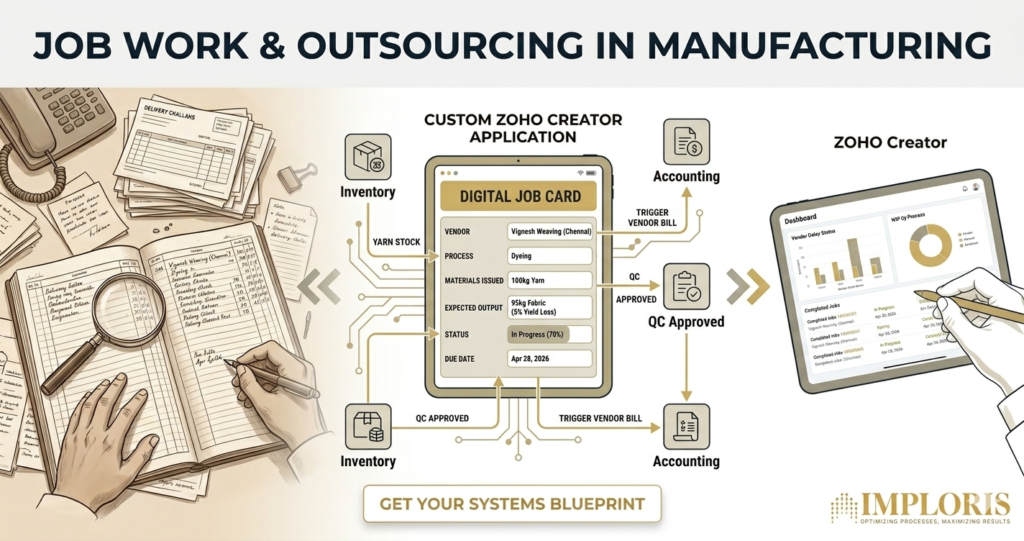
There’s a point in almost every growing manufacturing business where job work starts becoming difficult to manage.
Not because there are too many vendors.
Not because production is complex.
But because there is no clear way to see what is happening across jobs.
What it actually looks like on the ground
In many setups, job work is still managed the way it has been for years.
There are ledger books.
Sometimes a basic software sitting on one system.
And a lot of reliance on memory.
Vendors are known. Relationships are strong.
Work is assigned, materials are given, and the expectation is understood.
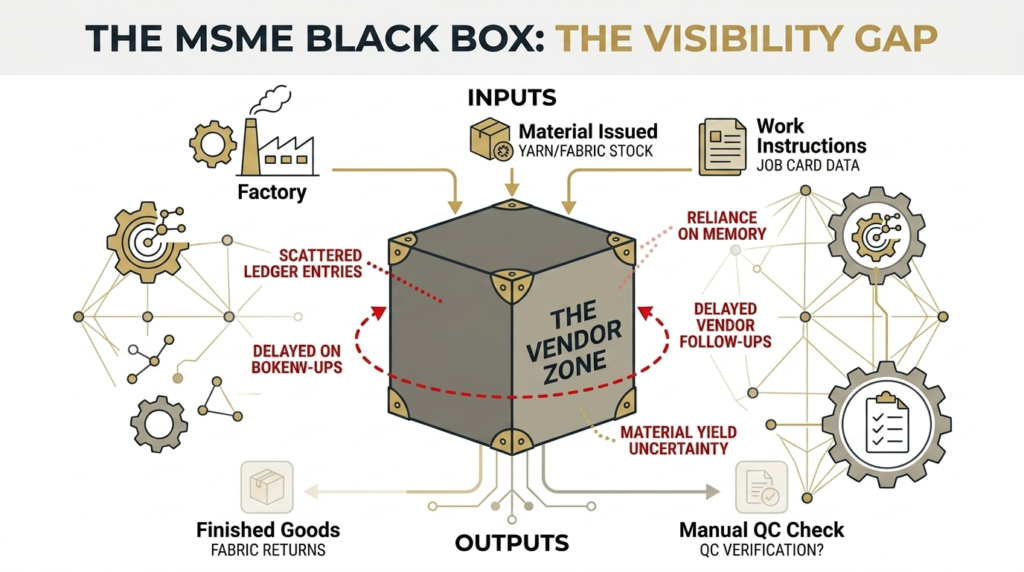
But everything in between is loosely tracked.
If you want to know:
- which job is with which vendor
- what was given
- what is expected back
- what is delayed
You don’t open a system.
You open a book.
Or you call someone.
The moment where things slow down
A simple question comes in:
“Which jobs are currently pending with this vendor?”
There is no quick answer.
Someone has to:
- go through entries
- trace past notes
- check what was issued
- confirm with the vendor
Even if the information exists, it is not readily visible.
And that is where things begin to slow down.
The problem is not tracking. It’s clarity.
Most businesses will say they are tracking job work.
And they are — in their own way.
But the issue is not whether data exists.
It’s whether the right information is captured in a usable way.
For example:
- Materials are issued, but not always tied clearly to a job
- Quantities are noted, but not always verified against return
- Quality is checked, but not recorded
- Delays are known, but not measured
So when something goes wrong, you don’t have a system to rely on.
You go back to:
- checking books
- asking people
- reconstructing what happened
Where the real cost shows up
On the surface, everything looks manageable.
But over time, the gaps start showing up in subtle ways.
A vendor delay pushes delivery timelines.
Materials get overused or under-accounted.
Rework happens, but no one tracks how often or why.
Sometimes it’s not even a dispute.
It’s just uncertainty.
- Was this material fully used?
- Did we issue more than required?
- Was this job delayed or just not followed up?
When there is no structured record, these questions don’t have clear answers.
And that’s where cost quietly accumulates.
What a structured job work system changes
When job work is handled through a proper system, the difference is not in complexity.
It is in clarity.
Instead of scattered entries, you have a single structure.
At the center of it is something simple:
A job card.
The role of a job card
A job card becomes the anchor for everything.
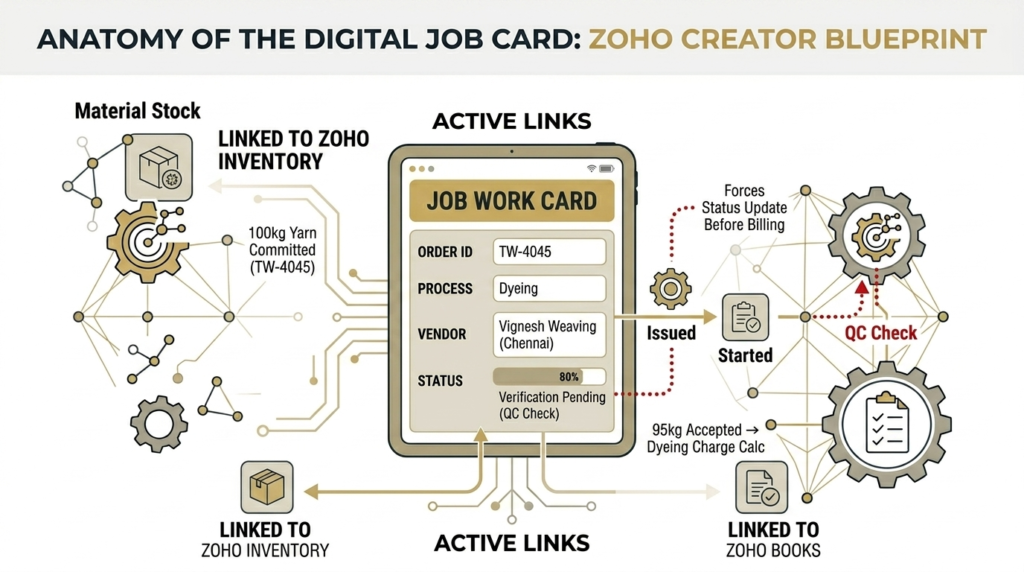
It captures:
- what the job is
- which vendor it is assigned to
- what materials are issued
- expected output
- timelines
- current status
As the job moves, the same record evolves.
Materials go out → recorded
Work progresses → updated
Finished goods come back → verified
Quality is checked → noted
Now instead of information being spread out,
everything sits in one place.
What becomes visible immediately
Once this structure is in place, things that were previously unclear become obvious.
You can see:
- which jobs are with which vendors
- how long they have been there
- what is delayed
- what has been completed
Material movement becomes clearer.
You know:
- what was issued
- what came back
- where there is variance
And most importantly,
you are no longer dependent on follow-ups to understand status.
Where Zoho Creator fits into this
This is where most businesses try to adjust existing tools.
But standard systems don’t handle this level of workflow detail well.
This is where Zoho Creator comes in.
Not as a tool to replace everything.
But as a layer that allows you to build the system your operations actually need.
It helps you:
- structure job cards
- track vendor-level work
- capture material movement
- record QC observations
- maintain a clear flow from job to output
And once connected with accounting and inventory systems,
it brings the entire process together.
The shift that actually matters
Job work does not break because outsourcing is difficult.
It breaks because:
the essential information is not captured in a structured and connected way.
Once that changes, everything else becomes easier.
- follow-ups reduce
- delays become visible
- material usage becomes accountable
- decisions become faster
If this feels familiar
If your current setup involves:
- manual tracking of job work
- reliance on ledger books or sheets
- vendor follow-ups for status
- limited clarity on materials and timelines
Then the issue is not scale.
It is structure.
How we approach this at Imploris
We don’t start by introducing tools.
We start by understanding:
- how jobs are assigned
- how materials move
- where visibility is lost
- what needs to be tracked at each stage
Then we design a system around that workflow
and implement it using Zoho Creator along with the necessary integrations.
If you want to understand how your current job work process can be structured better,
we can walk through it together.A focused discussion is usually enough to identify where things are breaking
and what a better system could look like.