
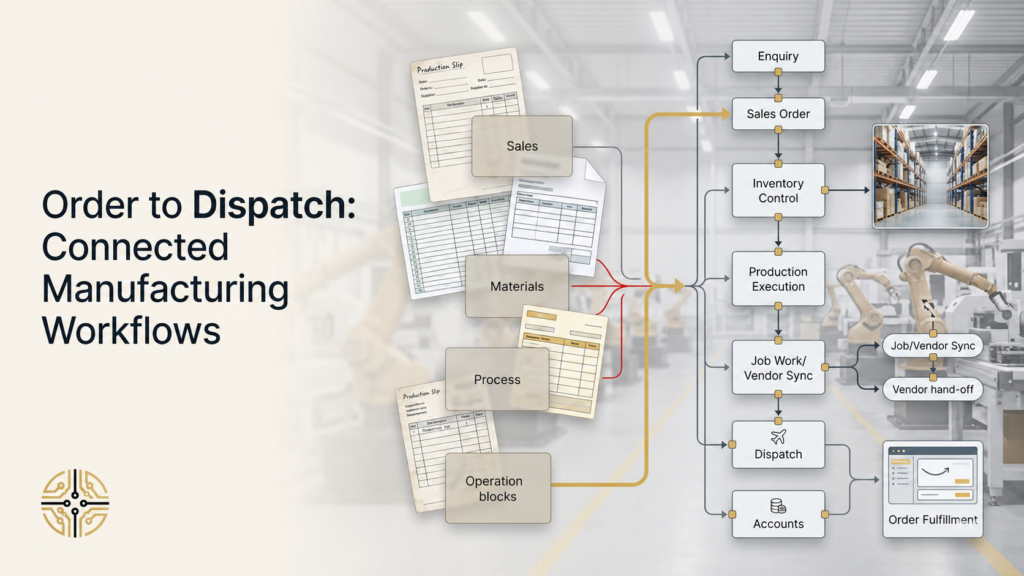
Most manufacturing workflows do not break at one point
They break in small invisible gaps between functions.
A customer order comes in.
Production gets informed.
Materials are checked manually.
Someone follows up with a vendor.
Dispatch is coordinated later.
The business is still functioning.
But the workflow itself is fragmented.
And over time, this creates operational stress that most growing MSMEs eventually struggle with.
Not because teams are not working hard.
But because the workflow between functions is not connected properly.
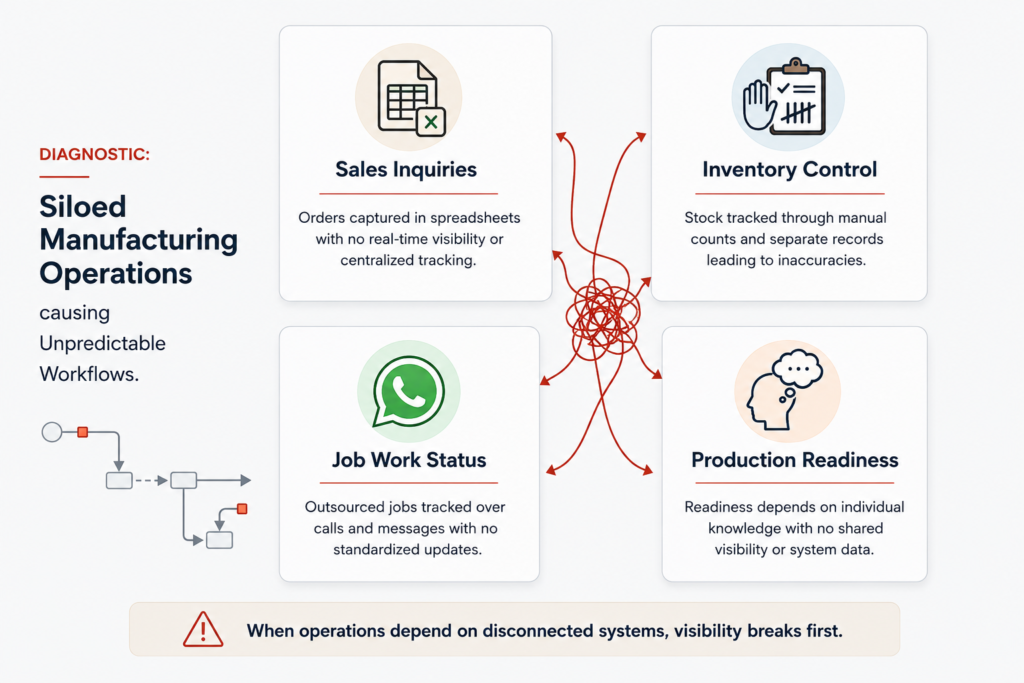
The reality inside many MSMEs today
In many manufacturing environments, the workflow between order and dispatch still depends heavily on:
- Excel workbooks
- notebooks
- WhatsApp updates
- manual follow-ups
- verbal coordination
And depending on the type of business, the operational structure may vary.
In some cases:
- customer orders are entered into a simple workbook
- production receives instructions manually
- outsourcing vendors are coordinated separately
- dispatch is handled based on follow-ups
Some organizations still rely on paper-based work orders or manual manufacturing slips.
Others use multiple disconnected systems where:
- accounts sit in one place
- stock sits in another
- production updates happen somewhere else
The problem is not necessarily the absence of effort.
The problem is the absence of connected visibility.
The workflow usually starts correctly
Most businesses already understand the basic operational sequence.
If finished goods are available:
- dispatch can happen directly
If not:
- production has to begin
That part is usually understood operationally.
But once multiple orders, production dependencies, vendors, and material movements enter the picture, the complexity increases quickly.
Now questions start appearing:
- Which orders are in production?
- Which jobs are delayed?
- Are materials available?
- Which vendor has picked up which work?
- What is pending dispatch?
- What is the expected completion timeline?
And this is where manual coordination starts becoming difficult.
Where workflows actually begin to break
The biggest issue is usually not production itself.
It is visibility into production.
For example:
- multiple orders may already be in queue
- raw materials may not be available
- outsourced jobs may still be pending
- production timelines may shift
- dispatch expectations may not align with reality
Without a structured workflow system, teams start depending on:
- calls
- WhatsApp messages
- manual updates
- individual memory
- follow-up culture
Eventually, the business becomes reactive.
Instead of operationally visible.
The stock and pricing problem many trading businesses face
This issue is not limited to manufacturing alone.
In some trading-oriented businesses, sales teams still do not have real-time visibility into:
- stock availability
- updated pricing
- pending inventory
- committed stock
Instead:
- periodic Excel sheets are circulated
- commercial teams manually update information
- sales teams verify availability separately
And by the time a large sales inquiry moves closer to closure, pricing or stock visibility may already be outdated.
This creates operational friction between:
- sales
- inventory
- accounts
- delivery commitments
Again, the issue is not effort.
The issue is disconnected workflows.
Order, inventory, and production should work together
Once a sales order enters the system, the workflow should immediately establish operational clarity.
The business should be able to understand:
- finished goods availability
- raw material availability
- production readiness
- manufacturing timelines
- dispatch expectations
This becomes even more important in manufacturing businesses where production execution depends directly on clear BOM management and material allocation, ensuring raw materials are committed before the floor begins work.
Without connected visibility, every department starts functioning separately.
And founders lose the ability to see the operational picture clearly.
Outsourced job work adds another layer of complexity
Many manufacturing MSMEs depend partially on external vendors or job work partners.
This creates another operational layer:
- material movement
- vendor assignment
- expected completion tracking
- follow-ups
- quality verification
- delivery dependency
In many businesses today, this is still tracked manually.
Someone knows where the job is.
Someone remembers who picked up the materials.
Someone follows up through calls or messages.
But the workflow itself is not visible structurally.
As scale increases, this becomes difficult to sustain consistently.
Quality control should not remain disconnected
Quality checks are often happening operationally.
But in many MSMEs, the quality data itself is not structured.
This creates a missed opportunity.
Because once deviations, defects, or rework patterns are recorded systematically:
- vendor performance becomes measurable
- recurring issues become identifiable
- variance reporting becomes possible
- operational improvements become easier
Without this visibility, quality management remains reactive.
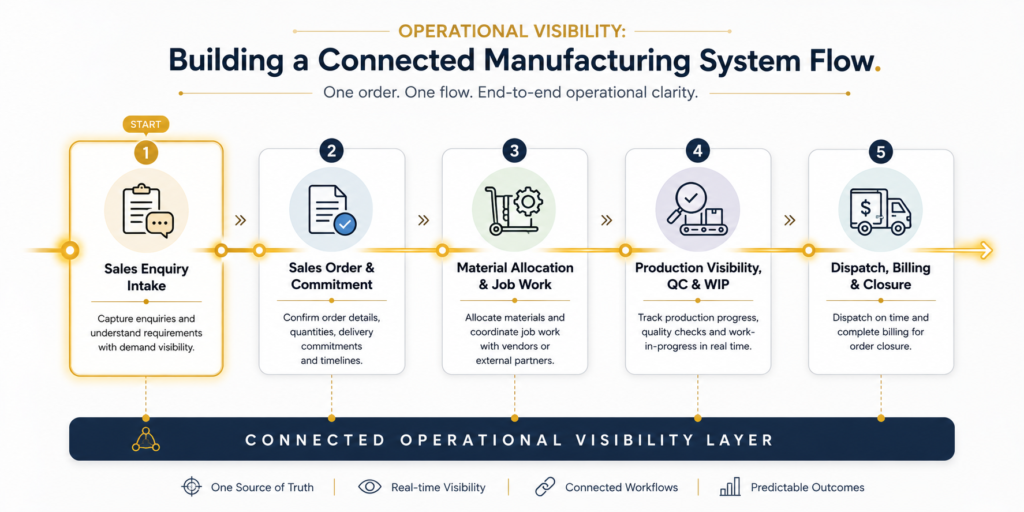
What an ideal manufacturing workflow should feel like
The goal of a structured workflow is not complexity.
It is operational clarity.
The moment a sales order is confirmed:
- production visibility should begin
- stock status should become visible
- work allocation should become trackable
- progress stages should update clearly
- dispatch readiness should become measurable
Every operational handoff should feel connected.
Not dependent on manual coordination.
Visibility changes operational control
Once workflows become connected:
- founders gain operational clarity
- production bottlenecks become visible
- dispatch planning improves
- inventory movement becomes easier to track
- delivery expectations become more reliable
Most importantly:
the business no longer depends entirely on people remembering operational movement manually.
The workflow itself starts carrying the visibility.
This is where structured manufacturing systems matter
This is exactly why many growing MSMEs eventually move toward connected operational systems. Not because they suddenly need a massive, rigid ERP system, but because a modular Semi-ERP approach gives them workflow visibility and connected execution without the unnecessary complexity
And this is where workflow-driven systems built using platforms like Zoho Creator start becoming extremely valuable.
Because they allow manufacturing businesses to connect:
- orders
- inventory
- production
- job work
- QC
- dispatch
- accounts
into a single operational structure.
Manufacturing workflows break when operations stay disconnected
Manufacturing workflows rarely fail because teams are not working hard.
They usually fail because:
- systems are disconnected
- workflows are fragmented
- visibility depends on manual coordination
- operational movement is not structured
And as businesses scale, these invisible gaps become harder to manage manually.
How we approach this at Imploris
At Imploris, we approach manufacturing workflows by first understanding how operations move between departments.
Not just theoretically.
Operationally.
We study:
- how orders enter the system
- how production begins
- how inventory is allocated
- how outsourcing is tracked
- where visibility gets lost
- how dispatch is coordinated
From there, we structure workflows that connect operations into a more visible and manageable system using the right combination of Zoho tools and custom operational layers where required.
The objective is not to complicate manufacturing operations.
It is to make operational movement visible across the business.
And often, a focused discussion is enough to identify where the workflow itself is breaking.