
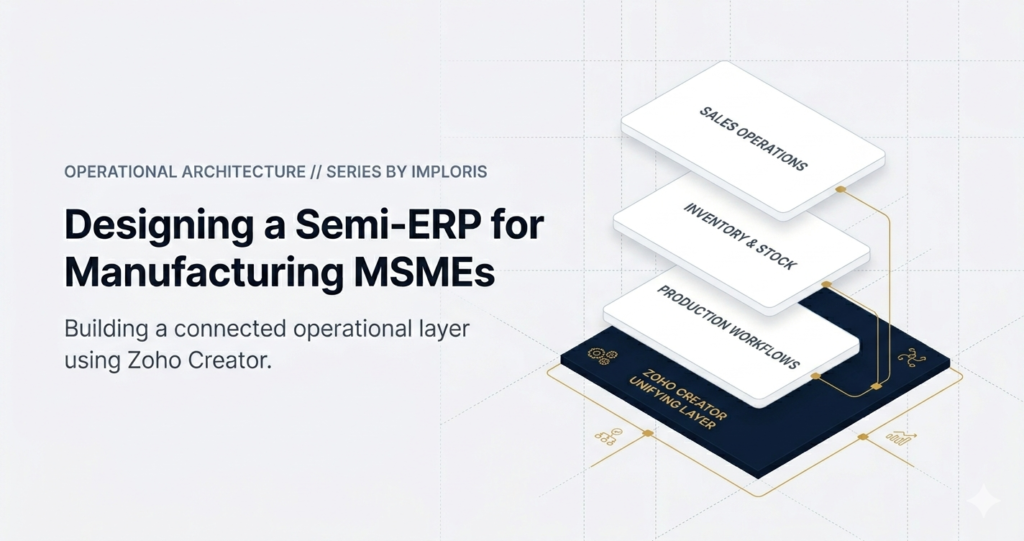
The point where operations stop being manageable
There’s a stage in most growing manufacturing MSMEs where things don’t exactly “break,” but they stop feeling clear.
Orders are increasing.
Materials are moving.
Teams are working.
But visibility starts disappearing.
A founder asks for a delivery update. Someone checks a sheet. Another person calls the floor. Stock is maintained somewhere else. Accounts sit in another system. And somewhere in between, WhatsApp becomes the operational bridge connecting everything together.
The business is functioning.
But it is functioning reactively.
Why Excel eventually becomes an operational burden
Most MSMEs don’t start with complex systems.
They start with what works:
- Excel
- Google Sheets
- Tally
- physical books
- WhatsApp coordination
And honestly, for a certain stage, that is completely fine.
The problem begins when the business grows but the operational structure does not evolve with it.
At that point, Excel stops being a simple tool and starts becoming an operational dependency.
Now the business depends on:
- manual updates
- disciplined entries
- someone remembering where information sits
- individuals maintaining structure manually
And this creates two major problems.
The first is data integrity.
The second is operational visibility.
Because once multiple teams start updating different pieces of information separately, the business no longer has a single operational picture.
The real issue is not software. It is visibility.
A common mistake many businesses make is assuming they need a “big ERP.”
That usually comes from seeing larger companies using systems like SAP or hearing that ERP is the next step toward growth.
But the reality is different.
Most MSMEs do not initially need a heavy enterprise ERP.
What they actually need is:
- connected workflows
- structured operations
- visibility across functions
- process-driven execution
Without this, even the best software becomes difficult to use.
Why full ERP systems often feel too heavy
Large ERP systems are designed for organizations with:
- higher operational maturity
- larger teams
- formalized processes
- dedicated system management structures
Many MSMEs are still evolving operationally.
Their workflows are changing.
Their teams are adapting.
Their production structures are becoming more complex gradually.
So implementing a massive ERP too early often creates friction instead of clarity.
Not because ERP is bad.
But because the business needs a system aligned to its current operational reality.
What a “semi-ERP” actually means
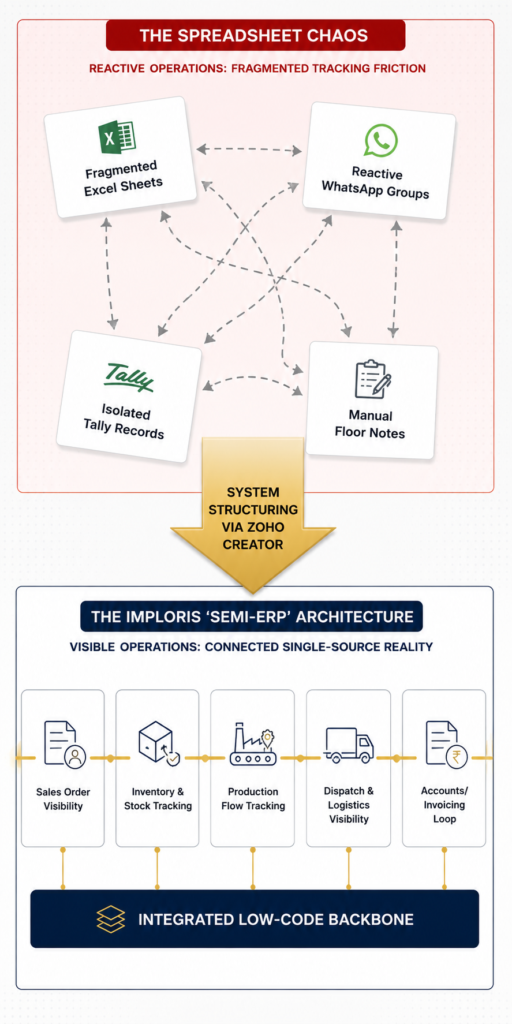
The term “semi-ERP” does not mean a half-built ERP.
It means a focused operational system designed around the workflows the business actually needs.
In practice, this creates something extremely valuable:
A connected operational layer.
One where:
- sales orders connect to inventory
- inventory connects to production
- production connects to dispatch
- accounting reflects operational movement
- leadership gets visibility across functions
The goal is not to automate everything.
The goal is to create operational clarity.
The shift from reactive operations to visible operations
This is usually the biggest transformation.
Before implementation:
- teams follow up manually
- information is scattered
- managers depend on updates
- founders rely on people for visibility
After implementation:
- workflows become visible
- operational bottlenecks become measurable
- timelines become trackable
- departments become connected
The business stops reacting to problems late.
And starts seeing operational movement as it happens.
What the core operational stack looks like
For most growing manufacturing MSMEs, the first layer of operational digitization does not need to be massive.
But it does need to be connected.
A practical operational stack usually includes:
- sales order visibility
- inventory and stock tracking
- production or manufacturing tracking
- dispatch visibility
- accounts payable and receivable
- operational dashboards for stakeholders
Once these areas are connected properly, the business starts functioning very differently.
Not because more software was added.
But because information starts flowing correctly.
Where Zoho Creator fits into this
This is where Zoho Creator becomes extremely powerful.
Not because it can “build apps.”
But because it allows businesses to create systems aligned to their actual workflow.
Most standard software handles specific functions well:
- accounting
- inventory
- CRM
- sales
But manufacturing MSMEs often need something in between:
- custom workflow tracking
- production visibility
- job-level coordination
- operational movement across functions
Zoho Creator fills this gap.
It acts as the operational layer connecting business processes together.
And because it integrates with tools like Zoho Books, Inventory, CRM, and Analytics, it allows businesses to build systems that feel structured without becoming unnecessarily complicated.
Visibility changes decision-making
Once operations become visible, leadership changes.
Stakeholders can:
- track operational flow
- identify bottlenecks
- measure pending work
- monitor production movement
- understand financial impact faster
Function-specific dashboards become possible.
Management no longer depends entirely on verbal updates or manual coordination.
And this becomes especially important once the business starts scaling.
Because growth without visibility creates operational stress very quickly.
Process discipline still matters
One important misconception needs to be clarified.
No system removes the need for operational discipline.
Even a well-designed manufacturing system still depends on:
- proper usage
- process ownership
- clear workflows
- structured updates
Technology supports execution.
It does not replace operational clarity.
Manufacturing MSMEs do not initially need a massive ERP
Most growing manufacturing businesses do not initially need a large enterprise ERP system.
What they need is:
- connected workflows
- operational visibility
- structured execution
- clarity across functions
Once those foundations are built properly, scaling becomes far more manageable.
How we approach this at Imploris
At Imploris, we approach manufacturing systems by first understanding how operations actually move inside the business.
Not just on paper, but in practice.
We look at:
- how orders flow
- how stock moves
- how production is tracked
- where visibility breaks
- where teams depend too much on manual coordination
From there, we design systems that connect workflows across sales, inventory, production, dispatch, and finance using the right combination of tools, including Zoho Creator where required.
The goal is not to make operations complicated.
The goal is to make them visible.
If your current setup still depends heavily on spreadsheets, disconnected systems, or manual follow-ups, there is usually an opportunity to structure operations more effectively.
And often, a focused discussion is enough to identify where those gaps exist.